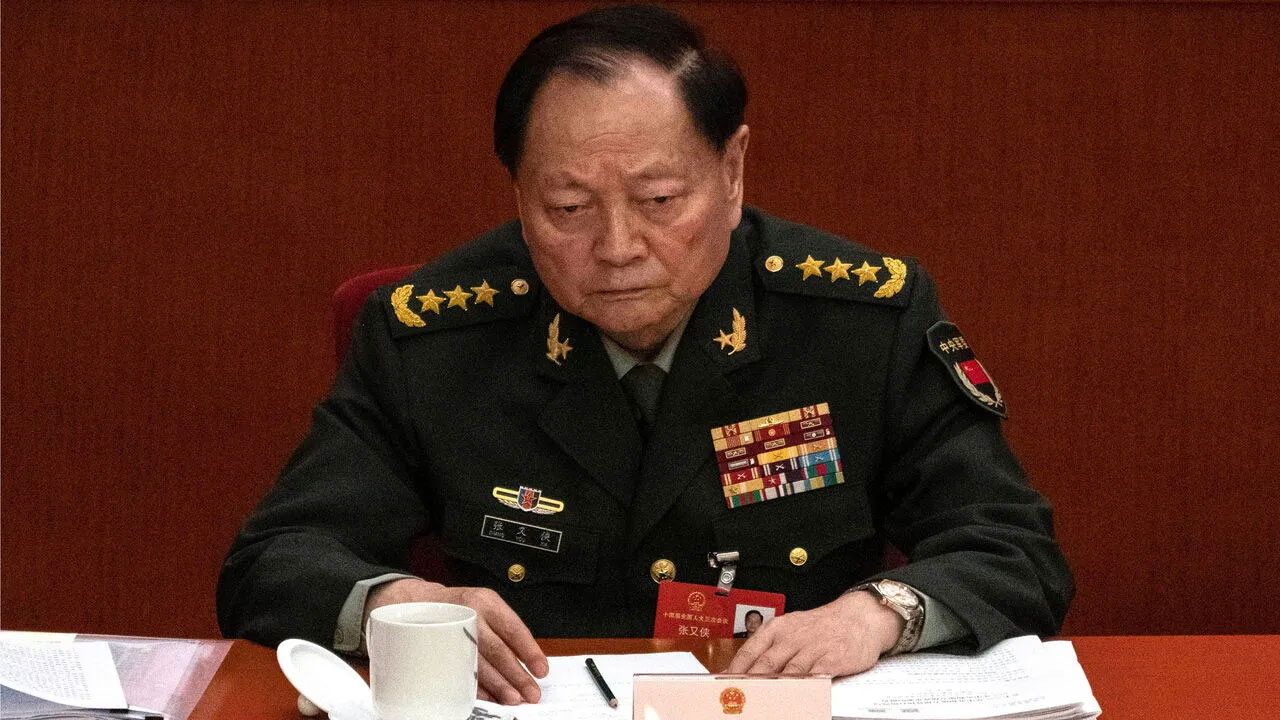
Recent headlines claiming that a senior Chinese general leaked nuclear secrets to the United States have generated a predictable wave of speculation. In some corners, the story has already escalated into claims of coups, regime instability, or an imminent shift in China's strategic posture.
These interpretations deserve a more measured assessment.
This is not an argument that nothing serious is happening inside China's military leadership. On the contrary, the removal of senior figures at the apex of the People's Liberation Army (PLA) is inherently significant. But significance should not be confused with sensationalism, and understanding elite politics in China requires a different analytical framework than the one often applied to Western political systems.
Why the Most Dramatic Claims Should Be Treated With Caution
Elite Chinese Communist Party (CCP) politics do not leak in the way Western politics do. At senior levels of the party and the military, unauthorized disclosure is not merely career-ending—it carries severe legal and personal consequences. Communications are tightly controlled, senior officials are subject to constant monitoring, and the incentive structure strongly discourages unsanctioned contact with foreign media.
For that reason alone, detailed claims about nuclear secrets circulating freely through journalistic channels should be treated with skepticism. This is not cynicism; it is a recognition of how the Chinese system is designed to function.
A similar caution applies to narratives involving coups or elaborate internal plots. When traced back to their sources, many of these claims originate in familiar ecosystems: overseas dissident networks, rumor chains, and outlets with a history of speculative reporting on China's internal politics. That does not make every claim false, but it does raise the evidentiary threshold required before drawing firm conclusions.
Where the Real Signals Are Found
In China, the most reliable indicators of internal political dynamics are not leaks but language—specifically, the phrasing used in official communiqués.
In this case, authorities accused the dismissed general of having "trampled on and undermined the Chairman responsibility system" of the Central Military Commission. This formulation is not incidental. Similar language has been used in previous cases involving senior military leaders who were accused of tolerating corruption, building alternative power centers, or failing to enforce discipline in ways that challenged centralized authority.
Under the current leadership model, loyalty is defined not merely by the absence of overt dissent but by rigorous compliance with directives, particularly on anti-corruption. Failure to implement those directives can itself be interpreted as political disobedience. From that perspective, the charges need not imply an attempted coup or ideological betrayal. They may instead reflect a judgment that authority was insufficiently enforced, corruption was allowed to fester, or command discipline deteriorated in ways deemed unacceptable.
It is also worth emphasizing what cannot be known. China's political system is opaque by design. Beyond what is formally stated, any interpretation necessarily involves inference. Assertions of certainty should therefore be viewed with caution. In many cases, the most honest analytical conclusion is simply that the full picture is not yet visible.
Implications for Taiwan and the United States
Paradoxically, large-scale purges within a military organization often signal internal consolidation rather than operational readiness. Removing senior commanders, dismantling patronage networks, and reasserting centralized control tend to introduce friction, slow decision-making, and disrupt institutional continuity.
From that standpoint, these developments may reduce near-term risk rather than increase it. A military focused inward—on discipline, loyalty, and structural control—is typically not at peak readiness for complex external operations. This is particularly relevant in discussions about Taiwan, where any serious contingency would require an exceptionally high level of coordination, confidence, and operational maturity.
For the United States and its allies, the episode appears less like a leadership losing control and more like one reinforcing it, even at the cost of short-term effectiveness. That distinction matters. It suggests a longer, more deliberate timeline for major strategic decisions rather than an abrupt acceleration toward conflict.
The Broader Lesson
The greatest analytical risk in moments like this is not underestimating China. It is misunderstanding how power actually operates within its political and military institutions.
Sensational narratives are tempting, particularly when information is scarce. But they often obscure more than they illuminate. A disciplined approach—grounded in institutional behavior, official language, and structural incentives—provides a more reliable foundation for assessing both China's internal dynamics and their external implications.
As with most questions surrounding elite Chinese politics, restraint remains a virtue. The signals are there, but they are subtle. Treating them seriously requires resisting the urge to turn opacity into certainty.