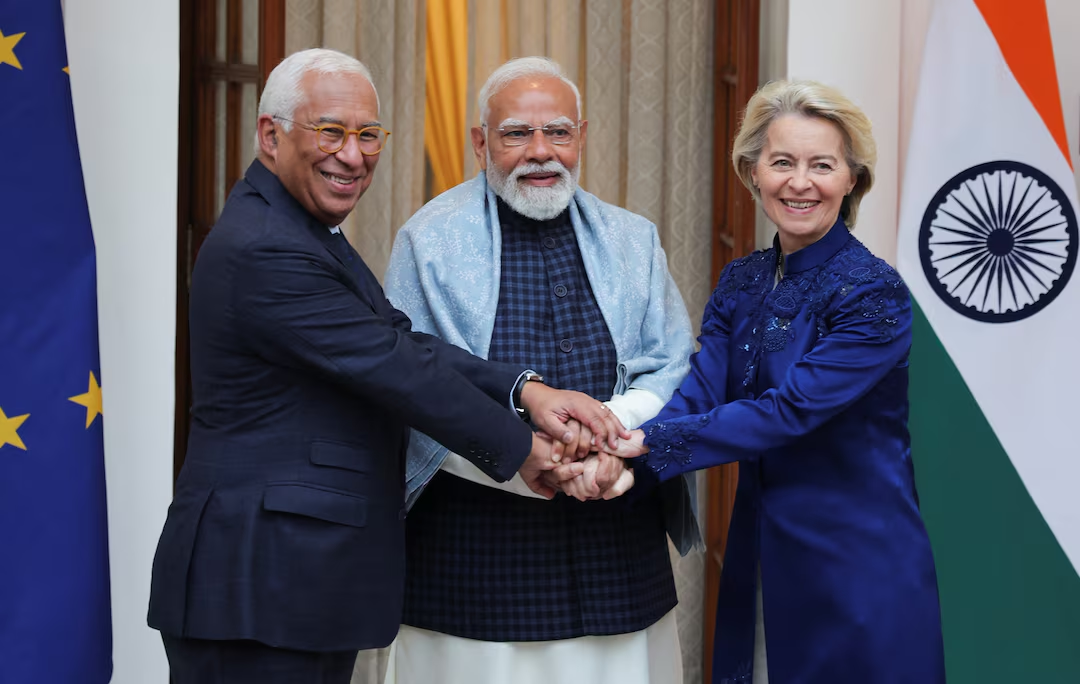
In late January, India and the European Union concluded what both sides have described as the "mother of all trade deals," a comprehensive free-trade agreement nearly two decades in the making.
On its face, the agreement is significant but unsurprising: tariff reductions, expanded market access, and deeper commercial integration between two of the world's largest economic blocs. Together, India and the EU account for roughly a quarter of global GDP and an even larger share of projected global growth over the next two decades.
What is surprising is not that the deal happened, but who is missing from it.
The United States.
A Deal Years in the Making — Suddenly Accelerated
Negotiations between India and the EU have dragged on since the mid-2000s, repeatedly stalling over agriculture, regulatory standards, labor rules, and market access for sensitive industries. For years, the incentives to compromise simply weren't strong enough.
That changed recently.
The final push to close the deal was driven less by economics than by strategic necessity. Both India and Europe found themselves navigating an increasingly unpredictable global trade environment one shaped by tariffs, retaliatory measures, and the re-weaponization of trade policy.
In that environment, waiting was no longer an option.
What Europe Actually Gets
This agreement is not symbolic. It delivers tangible, strategic benefits to Europe.
First, manufacturing and auto access.
Indian tariffs on European automobiles and industrial goods have historically been among the highest in the world, often exceeding 100%. The new framework sharply reduces those barriers, opening one of the fastest-growing middle-class consumer markets to European manufacturers.
Second, pharmaceuticals and industrial supply chains.
Europe gains preferential access to India's scale, not just as a consumer market, but as a manufacturing and processing base increasingly positioned as an alternative to China. This matters as European firms seek diversification without sacrificing cost efficiency.
Third, standards and long-term influence.
Modern trade agreements extend well beyond goods. They embed regulatory norms, technical standards, dispute-resolution mechanisms, and institutional alignment. By deepening economic integration with India, Europe extends its regulatory gravity into South Asia for decades to come.
This is not charity.
It is strategy.
Why This Wasn't a U.S.–India Deal
From a purely strategic perspective, this agreement should have been anchored by Washington, not Brussels.
India is a natural long-term trade partner for the United States:
- Favorable demographics
- Rapid economic growth
- A large and increasingly sophisticated manufacturing base
- Shared concerns about over-dependence on China
- Expanding defense and security cooperation
And yet, no comprehensive U.S.–India trade agreement exists.
The reason is not lack of opportunity. It is policy inconsistency.
Over the past several years, U.S. trade policy has oscillated between disengagement, ad-hoc tariff pressure, and transactional negotiation. While tariffs were often framed as leverage, they also introduced uncertainty not just for rivals, but for allies and partners.
As noted in coverage of the India–EU agreement, the deal was widely viewed as part of a broader effort by U.S. partners to seek alternatives to American trade volatility.
When trade policy becomes unpredictable, capital and commerce adapt accordingly.
What the United States Should Have Gained
Had Washington pursued a sustained trade framework with India, the upside would have been substantial.
Preferential access to India's manufacturing ecosystem, particularly in sectors critical to U.S. strategic interests:
- Advanced manufacturing and industrial inputs
- Semiconductors and electronics assembly
- Defense and aerospace supply chains
- Energy, including LNG and clean-tech deployment
- Digital services, data infrastructure, and fintech
Beyond economics, such a framework would have anchored India more firmly within a U.S.-aligned Indo-Pacific economic architecture, reinforcing strategic alignment without overt confrontation.
Instead, Europe stepped in.
Not because it is more dynamic —
but because it was more predictable.
What Comes Next for the United States
The India–EU agreement does not permanently exclude the United States from shaping India's economic future, but it does narrow the window.
If Washington intends to reassert influence in global trade, particularly across the Indo-Pacific, several shifts are now required.
First, move from tariffs to frameworks.
Tariffs can apply pressure, but they do not create durable alignment. Trade influence today is exercised through rules of origin, regulatory cooperation, investment protections, and standards-setting. Without these, U.S. firms remain exposed to uncertainty even where demand exists.
Second, prioritize strategic sectors over headline deals.
A comprehensive free-trade agreement may be politically difficult in the near term. But targeted sectoral agreements covering semiconductors, advanced manufacturing, defense supply chains, energy, and digital services would deliver most of the strategic upside without the risks of all-or-nothing negotiations.
Third, restore predictability as a strategic asset.
Capital values clarity. Supply chains value stability. Partners value consistency. Over time, predictability becomes a competitive advantage. Europe's success with India was not driven by speed or ambition, but by patience and institutional continuity.
Trade policy is no longer just an economic tool.
It is a mechanism of geopolitical alignment.
Deals left unsigned are not neutral. They shape the default pathways through which goods, capital, and influence flow.
The Larger Signal
This agreement is not evidence that global trade is collapsing. Nor is it an indictment of globalization.
It is evidence that global trade is re-routing.
India and Europe did not sign this deal against the United States.
They signed it without the United States.
That distinction matters.
The India–EU agreement is a reminder that leadership in global trade is not asserted through tariffs alone. It is earned through consistency, credibility, and long-term engagement.
This deal should have strengthened American influence in Asia.
Instead, it underscores a growing reality:
when Washington steps back, others step forward.