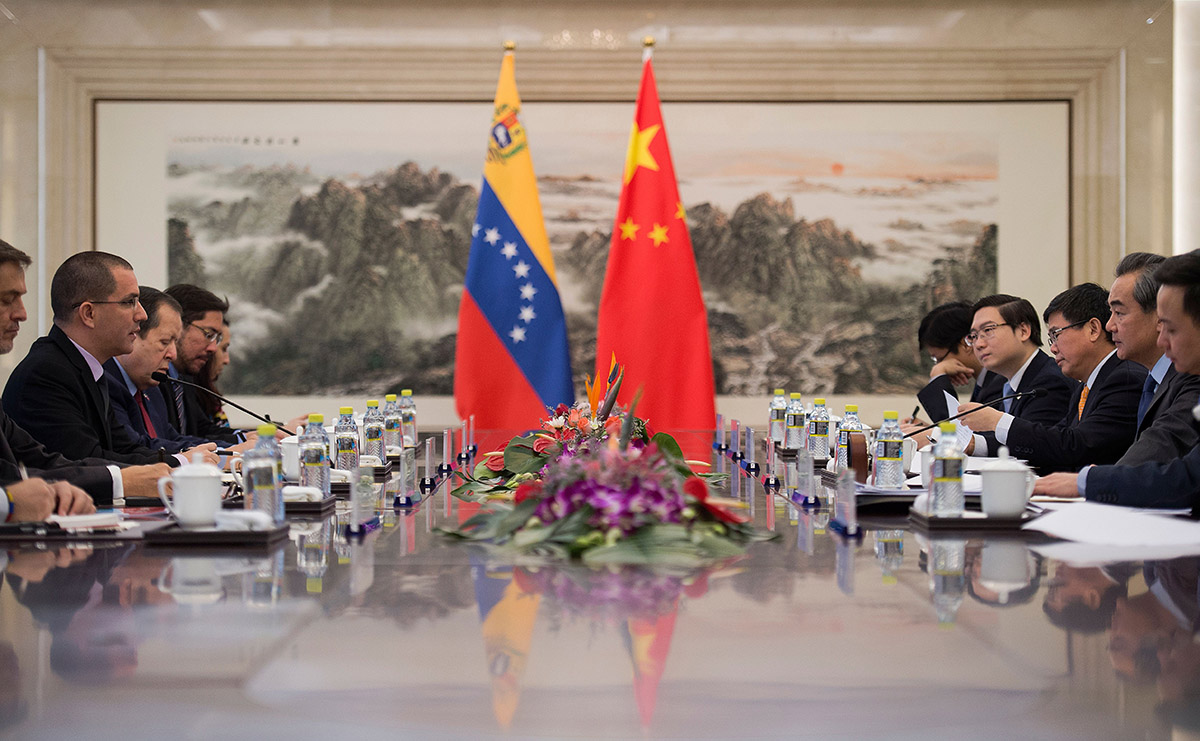
There is a new geopolitical fault line forming in the Western Hemisphere, and most people aren't watching it closely enough. For years, U.S.–China rivalry has been framed through the Pacific lens: Taiwan, the South China Sea, North Korean missile tests, and semiconductor supply chains. But a far more profound shift may be emerging to America's south, in Venezuela, where competing visions for world order are colliding over oil, sovereignty, and global influence.
The United States has dramatically increased its military posture in the Caribbean, surrounding Venezuela with warships, surveillance aircraft, special forces units, and the largest fleet presence in the region in decades. At the same time, China has stepped forward with its most forceful diplomatic endorsement yet of Nicolás Maduro's government, rejecting U.S. "unilateral bullying" and pledging support for Venezuelan sovereignty.
On paper, Venezuela is one more flashpoint in a world filled with overlapping crises: Ukraine, Gaza, Taiwan, the Red Sea shipping corridor. But the deeper story is far bigger: the Venezuelan crisis is revealing the emerging architecture of a multipolar world. It is where the United States' traditional hemispheric dominance meets China's global ambitions. It is where oil meets ideology; where geography meets great-power rivalry; where U.S. exceptionalism meets Chinese expansionism.
Why the U.S. Cares About Venezuela — The Real Strategic Layer
Let's start with the obvious: Venezuela is not Afghanistan or Iraq. It is not halfway around the world and it's not driven by theories of regime change, nor nation-building. Venezuela is on America's doorstep, sitting on a coastline that opens directly into the Caribbean Sea and Gulf of Mexico. Control over this geography means control over shipping lanes that feed the American energy economy and provide access to the U.S. Atlantic seaboard.
More importantly, Venezuela sits on the largest proven oil reserves on the planet, more than Saudi Arabia. In a world where energy security is becoming the defining strategic asset, those barrels are not just valuable; they are geopolitical leverage. U.S. refineries along the Gulf Coast were originally engineered to process Venezuelan heavy crude. When sanctions cut off that supply, America was forced to restructure refinery inputs, reshuffling an already fragile global oil market.
Energy doesn't just power economies it shapes alliances, military budgets, currency hierarchies, and inflation cycles. If Washington secures influence over Venezuelan oil, it controls pricing power far beyond the Caribbean.
And then there is proximity. The United States has always considered Latin America to be within its sphere of influence, a modern extension of the Monroe Doctrine. Allowing a Chinese-aligned nation to develop a protected energy base less than 1,500 miles off Florida's coast is a red line most U.S. policymakers will not accept. There is history here: when the Soviet Union placed missiles in Cuba, the world nearly entered nuclear war. The memory endures.
The China Factor: Why Beijing Is Stepping In
The new piece of the story, the one that makes Venezuela global, is China.
This week, Chinese Foreign Minister Wang Yi spoke directly with Venezuelan Foreign Minister Yvan Gil, reaffirming Beijing's support and rejecting U.S. threats of sanctions and military blockade. Chinese state messaging was blunt: unilateral bullying, sovereignty violation, and imperial interference.
This wasn't empty rhetoric.
China has spent two decades embedding itself into South America's commodity architecture. Venezuela is part of a broader strategy: deepen ties, secure resources, expand presence, reduce dependence on U.S. trade lanes, and build a diplomatic corridor through Latin America, historically the West's uncontested political domain.
For China, Venezuela is an energy play, a diplomatic wedge, and a proving ground for the decline of U.S. hemispheric control.
China has:
- financed infrastructure in Venezuela,
- purchased long-term oil contracts,
- supported Maduro diplomatically at the UN,
- and created a yuan-based settlement channel for Venezuelan crude.
It is not an accident that China backed Caracas' request to the United Nations Security Council to discuss "U.S. aggression." Beijing wants to frame Venezuela as the victim of American imperialism, a message that resonates across Africa, Southeast Asia, and the Global South, where China is expanding economic influence at U.S. expense.
The Russia Dimension
Add Russia to this equation and it becomes even more complicated.
Moscow has maintained deep military and intelligence connections with Caracas since Hugo Chávez. Russian aircraft, advisors, and technology still operate inside the Venezuelan military ecosystem. For the United States, watching a Russian-backed state become a geopolitical staging ground 2,000 miles from Miami creates an uncomfortable echo of Cold War history.
A Chinese-Russian overlay in Venezuela, inside America's backyard, is a direct challenge to Washington's global authority.
Why Venezuela Went to the UN
Another turning point came this week when Venezuela formally appealed to the United Nations Security Council for support, accusing Washington of preparing an illegal maritime blockade.
This wasn't symbolic. It was strategic.
By invoking UN jurisdiction, Venezuela dragged the conflict out of bilateral U.S.–Venezuela tension and into a global forum, where China and Russia are permanent Security Council members. China immediately backed the move.
Think about that: a Latin American nation asking China to protect it from a U.S. military crackdown, on U.S. regional waters, through a U.S.–designed international system. That is historic.
Domestic United States Politics Cannot Be Ignored
It would be naïve to pretend this confrontation exists outside of American domestic politics.
President Trump's decision to order a blockade on all sanctioned Venezuelan oil tankers may be grounded in strategic logic, but it also carries political narrative strength.
Showing force against a socialist government, in a year of intense border and energy debate, plays to Trump's core themes:
- national strength,
- immigration control,
- and American energy dominance.
A foreign conflict near U.S. waters shifts the political conversation. It creates a rally-around-the-flag dynamic. It draws attention away from economic turbulence. It feeds the idea that American strength must be restored.
Human Rights, Migration, and Economics
And beneath the great-power rivalry lie real human consequences.
Millions of Venezuelans have fled economic collapse, pouring across Latin America into Colombia, Brazil, Peru, and ultimately into the United States through the southern border. That migration pipeline reshapes U.S. politics and immigration law.
Meanwhile, economic conditions inside Venezuela remain severe. Inflation, poverty, and food scarcity have torn at the fabric of society. The Maduro government survives partly because of oil revenue, Chinese and Russian financing, and the lack of a unified opposition.
A U.S. blockade might accelerate regime collapse, but it could also deepen humanitarian suffering, raising ethical and diplomatic questions globally.
Why This Moment Matters
The Venezuelan crisis is bigger than Venezuela.
It is the clearest sign yet that the U.S.–China rivalry is no longer confined to Asia or trade policy. It is global, ideological, and maritime. Beijing is testing whether U.S. military threats can be neutralized through diplomatic coordination and soft-power partnership, without firing a shot.
Washington is testing whether its regional authority remains intact, and whether it can prevent Chinese influence from reaching into the Americas.
Venezuela is where these two tests meet.
The result will shape energy markets, migration patterns, and global diplomacy for decades.
The Future: Three Possible Trajectories
1. Negotiated De-escalation
The United States tightens sanctions, Venezuela concedes oil terms, and China maintains rhetorical support without military expansion.
2. Maritime Confrontation
U.S. forces seize more tankers; Venezuela retaliates economically; China expands naval presence — raising the risk of miscalculation.
3. Structural Realignment
Latin America becomes a major theater in U.S.–China rivalry, with new alliances, new currency channels, and new military partnerships forming.
Number three is increasingly likely.
Conclusion: Venezuela Is a Preview of the Post-American Order
We are witnessing the opening pages of a new geopolitical era. The United States and China are no longer competing in isolated theaters, they are contending everywhere, including in places Washington once considered unchallengeable.
If the 20th century Cold War was defined by Europe, the 21st century competition may be defined by the Caribbean and the Pacific, the waters that carry energy, trade, and military projection power.
Venezuela sits squarely in the middle of that map.
And whether this ends with diplomacy, confrontation, or realignment, one thing is clear: the world is no longer waiting for America to write the rules alone.